


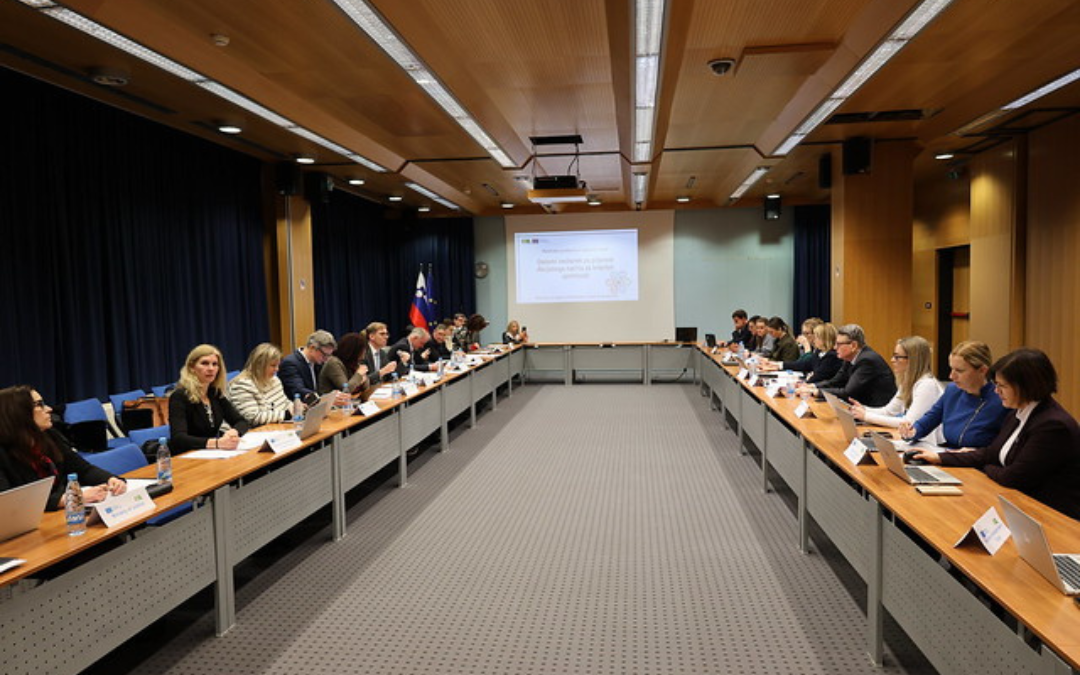
At the end of January, the Ministry of Cohesion and Regional Development hosted a meeting with representatives of the European Commission in Ljubljana. Skills development and the future direction of European funding were at the centre of the discussion. The main guest was Andriana Sukova, Deputy Director-General of the Directorate-General for Employment, Social Affairs and Inclusion. The discussion focused on preparing the Skills Action Plan and exploring how European funds could be used more effectively to support human capital development.
The event was designed as a dialogue between national institutions, social partners and the European Commission. Following a meeting between senior representatives of the European Commission and the Minister of Education, Vinko Logaj, a morning working session was held with representatives of the relevant ministries. I attended as a representative of the Slovenian Institute for Adult Education.
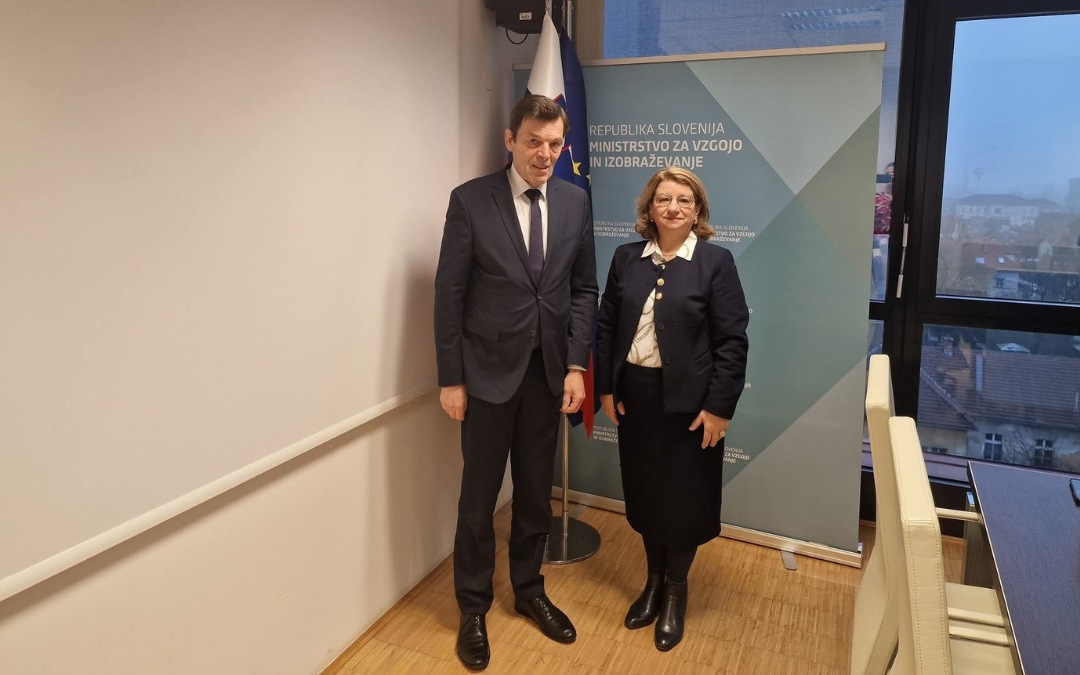
The meeting was intended as an exchange of views on skills development and the more effective use of European funds. The discussion focused on aligning policies and ensuring that the system responds more effectively to the needs of the labour market and society. In this context, Andriana Sukova highlighted the need to motivate adults to engage in lifelong learning and encourage employers to support training, noting that ‘skills are a key driver of Europe’s competitiveness’. For this reason, shortly after the opening remarks by the State Secretaries of the Ministry of Cohesion and Regional Development and the Ministry of Education, I was invited to speak. I presented the findings of a national survey on awareness of lifelong learning through the lens of population segmentation among people aged 15–75 (the presentation is available in Slovenian). The survey was conducted for us by the agency Arhea as part of the Awareness-Raising for Lifelong Learning project. One of the most striking findings was the large gap between the proportion of the population that fully recognises the importance of lifelong learning (67%) and the proportion of those who know which knowledge and skills they still need to acquire (20%). The segmentation approach itself was also commended, as it will serve as the basis for designing the most effective strategies to strengthen awareness among specific adult target groups.
The results of the survey were reflected in Andriana Sukova’s closing remarks and continued to be referenced after the working session had concluded. They were also cited during the afternoon panel discussion, to which representatives of the Chamber of Commerce and Industry, the Employment Service of Slovenia, the Institute of Macroeconomic Analysis and Development, trade unions and the SIAE were invited. The discussion addressed the current state of skills development in the European Union and in Slovenia, opportunities to improve adult education with a particular focus on reskilling and upskilling, the role of employers and employees, as well as the challenges and opportunities arising from strategic policy documents. Particular attention was devoted to the European Pillar of Social Rights and to the proposal for the Multiannual Financial Framework for the period 2028–2034.
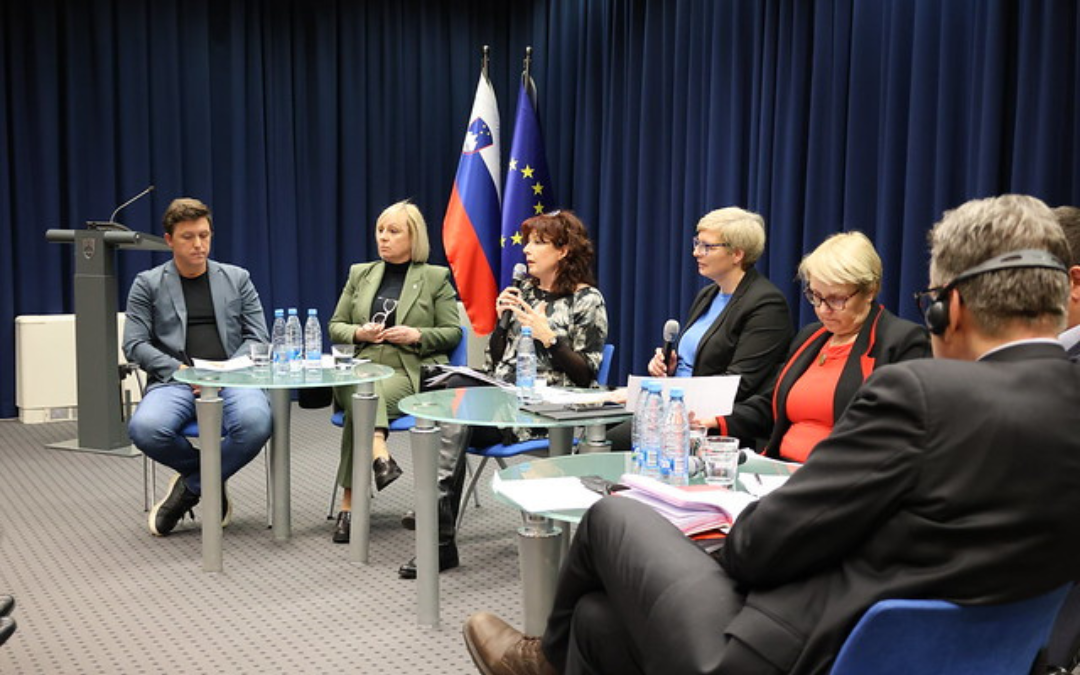
During the panel discussion, I primarily responded to questions related to the evaluation of current practice and the quality of investments, their strengths and development needs, as well as the need for a stronger role for employers and trade unions and better policy coordination.
In this context, the preparation of a Skills Action Plan as an additional strategic document also came to the fore.
In my contribution, I emphasised that Slovenia already has a valid and substantively comprehensive strategic document in the field of adult education, namely the Resolution on the Adult Education Master Plan in the Republic of Slovenia for the 2022–2030 period (ReAEMP22–30), which is aligned with European priorities and closely linked to the country’s broader development goals. I therefore stressed that the principal challenge lies not in the absence of a strategy, but in its consistent implementation and in the monitoring of its effects. I also noted that the SIAE is currently preparing a national mid-term evaluation of the ReAEMP, which will provide a clearer picture of which measures in adult education – not only those related to skills for the labour market – require further strengthening.
I also highlighted data from the most recent Labour Force Survey (LFS, four-week reference period), indicating that Slovenia exceeds the EU average in adult participation in lifelong learning, particularly in non-formal education. This demonstrates that the system functions and that mechanisms enabling access to learning are already in place. The key question for the coming period is therefore how to ensure greater policy coherence, more effective monitoring of results and long-term stability of implementation, which is closely linked to stable funding. During transitions between successive cohesion programming periods, the field is exposed to increased risk, as fewer resources are available for the development and delivery of formal and non-formal programmes as well as for the full range of support activities for adult education.
The discussion confirmed that skills development is a shared responsibility of the state, employers, trade unions and educational institutions. Social partners emphasised the importance of aligning programmes with the needs of the economy. In this context, I underlined that basic skills – reading literacy, numeracy and adaptive problem solving – must form the basis for the development and effective use of all other skills, including digital and occupation-specific skills. Their acquisition requires, among other things, stronger involvement of employers’ organisations and trade unions in upskilling and training programmes, alongside a renewed emphasis on social dialogue concerning access and inclusion.
The European Commission has accepted a number of Slovenian institutions into the Skills Pact, including the SIAE. We have therefore become part of a European community committed to promoting high-quality investment in skills development, as well as the upskilling and reskilling of the workforce. Membership brings opportunities for further networking and access to professional knowledge resources. Progress and relevant developments will also be shared through the SIAE Newsletter and other SIAE communication channels. In the 2026–2027 period, related activities will be implemented within the framework of the European Agenda for Adult Learning (EAAL) project. We will encourage adult education organisations and other institutions to join this initiative.
The meeting with the European Commission provided an opportunity for open professional dialogue and for a clear presentation of the Slovenian adult education system as a stable and forward-looking field. The exchange reflected a shared commitment to strengthening skills as a fundamental driver of social and economic resilience.
For the SIAE, it remains essential that all future initiatives are embedded within the existing national strategic framework. The emphasis should be placed on effective implementation, systematic monitoring of outcomes and the long-term stability and quality of the adult education system.
Dr Nataša Potočnik (natasa.potocnik@acs.si), SIAE